
Walk into a Sugar Land master bath from 2012 and you'll see the same thing every time: a jetted tub nobody uses, a glass-block shower that lets in murky light, and a double vanity with those builder-grade mirrors that somehow make everyone look tired. Homeowners knew it felt dated; they just weren't sure what to replace it with. That uncertainty is gone now. The clients we're working with in 2026 walk in with clear priorities, and those priorities are noticeably different from what people were asking for even three years ago.
This isn't about chasing what's new. Most of the choices Houston homeowners are making right now are driven by climate reality, how they actually use their bathrooms every morning, and — honestly — the lesson a lot of people absorbed after Beryl: if something in your house isn't working hard, it probably needs to go.
The Walk-In Shower Isn't Optional Anymore — But the Execution Matters
The soaking tub is still available as an upgrade. I've watched it shift from "must-have" to "nice-if-the-space-allows" over the past five years, and in 2026 it's closer to optional than ever. What's replaced it isn't just a shower — it's a specific kind of shower, and the details are where people are spending their remodeling dollars.
Curbless, barrier-free showers with large-format tile (we're doing a lot of 24×48 slabs right now, sometimes running floor to ceiling on a single feature wall) and linear drains placed along the back wall. That linear drain placement isn't aesthetic preference alone — on a slab foundation, which is the majority of homes in Katy and Pearland, the plumber has to core the concrete to relocate a drain. A back-wall linear drain usually requires less horizontal travel than a centered floor drain, which keeps the demo scope tighter and the budget from ballooning. Small detail. Real money.
Rain heads are standard now. What's getting added alongside them: body sprays on a separate valve and a handheld on a slide bar. Not because it's luxurious — because Houston's heat means people shower twice a day from May through October and they want the experience to actually feel good. That's a practical calculation, not an indulgence.
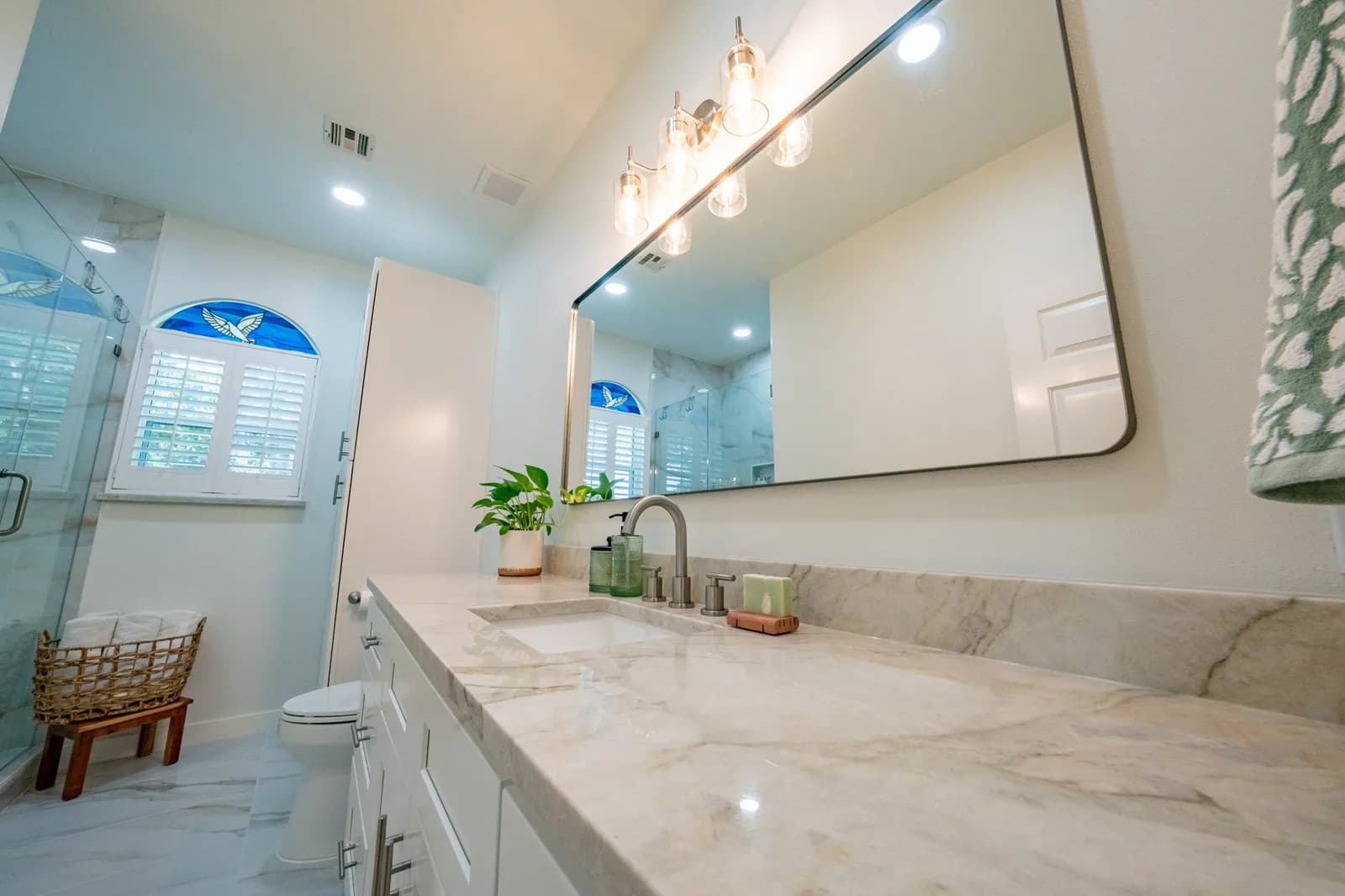
The tile trend worth paying attention to: warm-toned, natural-looking materials. Travertine-look porcelain, limestone-effect slabs, sandy beige with visible veining. The cold gray-and-white palette that dominated from about 2016 through 2022 is fading fast. Clients who locked into all-gray tile are already asking about refresh options.
Vanity Storage Is Getting Smarter, Not Just Bigger
Double vanities aren't going anywhere in primary baths — Houston homes have the square footage to support them and buyers expect them. But the conversation has shifted from size to storage logic. The request we hear constantly now: "I want to actually be able to find things."
That translates to a few specific changes:
- Drawers instead of doors on the lower cabinet runs, almost across the board
- Integrated electrical outlets inside the vanity cabinet (for charging toothbrushes and hair tools without cluttering the counter)
- A dedicated charging drawer or pull-out organizer for devices
- Floating vanities at 36 inches height rather than the old 32-inch standard, which makes a visible difference in back comfort for anyone over 5'8"
- Lighted mirrors or medicine cabinet mirrors with built-in LED — not a sconce on each side of a flat mirror, which was the standard move for years
The medicine cabinet is making a real comeback, specifically the recessed, frameless version with interior lighting and USB ports. In a Heights bathroom where wall depth is limited by 2×4 framing in a 1940s bungalow, you're sometimes only getting 3.5 inches of recess, which is enough for a shallow cabinet but requires knowing exactly where your studs and any horizontal blocking sit before you commit to a location. That's the kind of thing you find out with a stud finder and a demo patch, not from a catalog.
One material worth mentioning: fluted wood or wood-look panels on the vanity face. It's been popular in Europe for a while and it's arrived here in force. It reads warm without being country, which is a hard line to walk in a contemporary bath. The trade-off is honest: fluted surfaces collect dust and toothpaste splash in the grooves. If you have young kids, you'll know about it. If it's a guest bath that gets used twice a month, it looks great indefinitely.
Lighting and Ventilation: The Two Things That Make or Break a Houston Bathroom
Houston's humidity doesn't negotiate. A bathroom that isn't properly ventilated is a bathroom that grows mold behind the tile, and no finish choice fixes that. The trend toward sealed, spa-like bathrooms with minimal windows has to be matched with serious exhaust capacity — we're speccing 110 CFM fans minimum now in primary baths, and often pairing them with humidity-sensing switches so the fan runs as long as the air is wet, not just as long as someone remembers to flip a switch. That's a code-compliant detail that's becoming a standard expectation, not an upgrade.
On lighting: layered is the word, but what it actually means in practice is three separate circuits. Recessed ambient light on a dimmer, task lighting at the mirror (either a lighted mirror or a dedicated vanity bar), and an accent layer for the shower or a toe-kick detail under a floating vanity. Three circuits means three switch locations or a smart panel — plan that rough-in before the drywall goes up, because adding it later involves opening walls.
Color temperature matters more than most people realize. 2700K (warm white) at the vanity makes skin tones look human. 5000K (daylight) makes the same mirror feel like a doctor's office. We see a lot of bathrooms where a client chose the right fixture and the wrong bulb temperature and now they avoid that bathroom in the morning. Specify the Kelvin rating, not just the fixture.
Natural light is having a moment too, specifically through privacy-glass windows and skylights. The Houston sun is brutal, but a well-placed 24×24 solar tube in a windowless interior bathroom changes the entire feel of the space without any structural drama. Permit requirements are minimal and the installation is a one-day job.
What these choices have in common is that they're calibrated to how people actually live here — in heat, in humidity, in houses that were built fast in subdivisions and are now asking to be made into something worth keeping. The trends that are sticking aren't the flashy ones. They're the ones that hold up in a Gulf Coast summer and still look right five years from now.
If you're thinking through a bathroom renovation and want a straight conversation about what makes sense for your home's layout and budget, we offer free consultations — /request.