
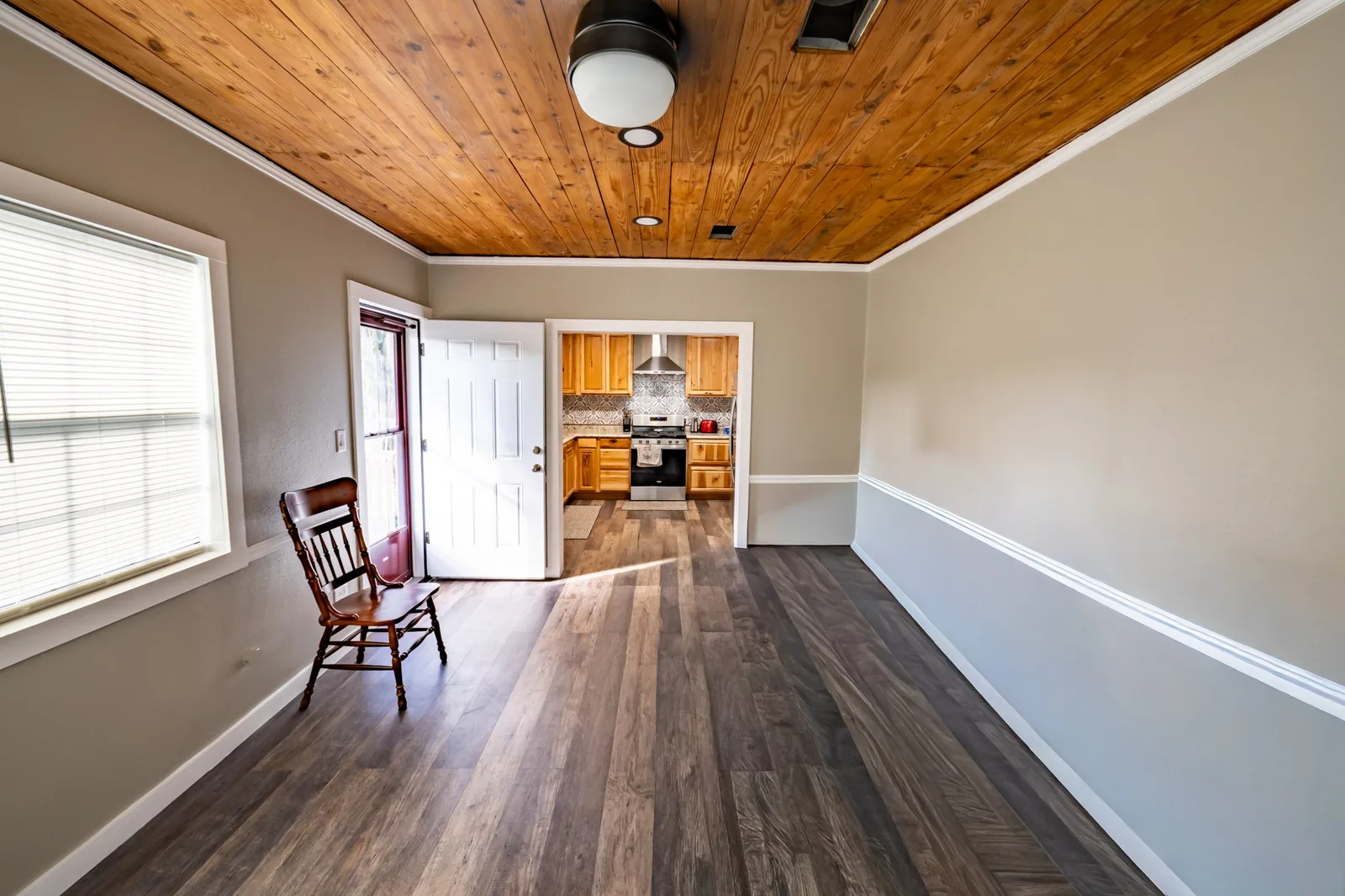
Pull up any Houston flooring showroom on a Saturday morning and you'll find the same argument happening at three different displays simultaneously. Someone from Pearland is holding an LVP plank next to an engineered hardwood sample, trying to feel the difference. A couple from the Heights is asking whether their 1960s slab can even take solid wood. A dad from Katy has a golden retriever and two kids under ten and just wants to know what survives. The question is always the same: which floor is actually right for a Houston living room?
The honest answer is that it depends on exactly two things — which floor of your house you're covering and how much water that room has ever seen. Everything else is secondary. This post will give you a straight cost breakdown, a performance comparison across the dimensions that actually matter here, and a plain recommendation by scenario, including the downside of each choice.
What Houston's Climate Does to Flooring That Most Guides Ignore
Houston averages around 50 inches of rain per year and sits at relative humidity that runs 75–90% on summer mornings before the AC fights it back down. That's not a footnote — it's the central design constraint. Wood moves with moisture. It expands when humidity climbs and contracts when the AC runs hard. A solid red oak floor installed in January at 35% indoor humidity can gap noticeably by August if the house isn't kept consistently cool. We've seen it happen in beautifully renovated homes in Montrose where the owner travels and lets the thermostat drift.
The slab-on-grade situation compounds this. Most Houston homes below the second floor sit on concrete slabs that were poured directly on grade. Concrete is porous. Even a slab that tests dry in February can wick moisture through the capillary structure during a wet spring. Before any flooring goes down on a slab, we run a calcium chloride test (ASTM F1869) or an in-situ relative humidity probe (ASTM F2170). If the reading is above 75% relative humidity inside the slab, you need a vapor barrier — full stop. Skipping that step and laying a floating floor is how you end up with cupped laminate six months later.
Installed Cost Breakdown for a 300–400 Sq Ft Living Room
Prices below are our installed rates per square foot — the same numbers our online estimator uses — shown for a standard 350 sq ft Houston living room. We confirm the final number after an on-site look at your slab or subfloor.
Luxury vinyl plank (SPC core, 12–20 mil wear layer):
- Installed: $13.50 per sq ft
- 350 sq ft living room: $4,725
High-end laminate (AC4/AC5 wear layer, attached pad):
- Installed: $11.25 per sq ft
- 350 sq ft living room: $3,938
Engineered hardwood (3-ply or 5-ply, ⅜–¾" thick):
- Installed: $18.00 per sq ft
- 350 sq ft living room: $6,300
Solid hardwood (site-finished, nail-down):
- Installed: $18.00 per sq ft
- 350 sq ft living room: $6,300
Laminate is the least expensive option here, about $790 less than LVP for a 350 sq ft room. Engineered and solid hardwood are priced the same at $18.00 per sq ft installed, so the choice between them comes down to your subfloor and how long you plan to stay, not budget.
Water and Humidity Resistance: The Gulf Coast Deciding Factor
SPC-core LVP is the only product in this comparison that is genuinely waterproof. The stone-plastic composite core does not absorb water. The joints on a quality click-lock SPC floor will resist surface flooding for 24–72 hours before water migrates underneath, depending on the product. If your living room has flooded — from Harvey in 2017, from Beryl in 2024, or from an HVAC condensate line that dripped for a week — LVP will survive where everything else fails.
High-end laminate has gotten better. AC4 and AC5 products with sealed edges and attached moisture barriers handle daily spills fine. But laminate is a wood-fiber core. Extended moisture — a wet dog shaking off near the baseboard, a slow leak from a wall — will cause swelling at the edges. It is water-resistant, not waterproof. That distinction matters on a Houston slab.
Engineered hardwood sits in the middle. The cross-ply construction makes it dimensionally more stable than solid wood, and it will tolerate Houston's humidity swings without gapping the way solid wood can. It is not flood-tolerant. It is not for rooms that have seen standing water.
Solid hardwood on a first-floor Houston slab is a risk we'll always name plainly. It can be done — with a proper vapor barrier, a glue-down or floating installation, and a homeowner who keeps indoor humidity between 35–55% year-round. I've watched beautiful solid walnut floors installed in a River Oaks home stay perfect for fifteen years under those conditions. I've also watched the same product buckle in a Pearland house after one bad slab leak. The floor doesn't decide. The slab and the owner's maintenance habits decide.
Scratch, Dent, and Pet Tolerance
LVP with a 12 mil or thicker wear layer handles dog nails and high heels well. The surface is a printed film over a rigid core — it resists scratching but dents are essentially permanent because there's no wood fiber to compress and spring back. Drop a cast iron skillet on SPC and you may chip it.
Laminate at AC4/AC5 rating actually outperforms LVP on scratch resistance. The aluminum-oxide wear layer is harder than the urethane finish on most LVP. The trade-off is that laminate edges chip more easily and water damage is irreversible.
Engineered and solid hardwood scratch. Period. A 3mm veneer on engineered hardwood can be lightly sanded once or twice before you're through the wear layer. Solid wood can be refinished 3–5 times over its life, which is the strongest long-term argument for the category. For families with large dogs or kids who drag furniture, hardwood requires either accepting the patina or committing to a harder species — hickory at 1,820 on the Janka scale or white oak at 1,360, versus a southern yellow pine down around 690.
First Floor vs. Second Floor: This Changes the Whole Answer
This is the axis most guides skip, and it's the most important one for Houston homeowners.
First floor on a slab: Moisture testing is mandatory. A vapor barrier is likely. LVP is the lowest-risk choice. Engineered hardwood is viable if the slab tests well and you use a moisture-blocking adhesive or a 6-mil poly barrier under a floating install. Laminate is medium risk. Solid hardwood glue-down on a first-floor slab is possible but requires ideal slab conditions and a committed homeowner — we always make sure clients understand the full picture before they choose it.
Second floor on a wood subfloor: The calculus flips. Flood risk drops to near zero. Now the questions are deflection, squeak, and sound transmission to the room below. A wood subfloor with 16-inch joist spacing and ¾-inch plywood sheathing in good condition can carry solid hardwood without issue. Where we see problems is wide joist spacing or thin sheathing — the kind of framing that turns up in some 1980s Katy tract homes — where the subfloor has too much flex for a nail-down installation to stay tight. In those cases we either sister the joists or switch to a floating engineered product. Sound transmission is a real concern in two-story homes; a rubber-backed underlayment under LVP or laminate will reduce impact noise to the room below better than a glue-down hardwood.
On-site, the thing we check before anything else on a second-floor living room is subfloor deflection: walk the perimeter, feel for bounce, check the joist direction against the planned plank direction. If the floor bounces more than L/360 under foot load, the conversation starts with structure, not materials.
Lifespan, Refinishability, and Resale
Here's the honest trade-off, stated plainly:
- LVP lifespan: 20–30 years with normal use, not refinishable, replaced not repaired
- Laminate lifespan: 15–25 years, not refinishable, replaced not repaired
- Engineered hardwood lifespan: 25–50 years depending on veneer thickness, light sanding 1–2 times
- Solid hardwood lifespan: 50–100 years, refinishable 3–5 times
Resale in Houston: Harris County Appraisal District doesn't line-item flooring, but real estate agents in the Heights, West University, and Bellaire consistently report that visible hardwood — engineered or solid — photographs better and draws faster offers than LVP in the $400,000-and-up price range. Below that threshold, buyers in Sugar Land and Pearland routinely prefer clean LVP over tired hardwood because they don't want the maintenance conversation.
For a full living room remodel that also touches trim and paint, we can coordinate the flooring alongside the rest of the work — see our general remodeling services for how we approach those combined scopes.
How They Sound and Feel Underfoot
LVP on a slab with a thin foam underlayment sounds hollow and clicks lightly underfoot. The 1–1.5mm pad most SPC products ship with helps but doesn't eliminate it. Add a 2mm cork underlayment and it improves significantly. SPC core is denser than WPC and sounds less hollow, which is one reason we spec SPC over WPC for living rooms.
Laminate has the same hollow problem, sometimes worse, because it's a thinner product. The attached-pad versions are better than bare laminate, but in a quiet house you'll hear every footfall.
Hardwood — solid or engineered glued down — is simply quieter and denser underfoot. It feels more substantial because it is more substantial. That's not a sales pitch; it's physics.
Which Floor to Specify, and the Downside of Each
First-floor Houston living room, any flood-risk area: Specify SPC-core LVP, 12 mil wear layer minimum, 6mm total thickness minimum. It is the only genuinely waterproof option. The downside: it can't be refinished, it shows dents from impact, and in homes above $400,000 it may underperform hardwood at resale.
First-floor Houston living room, no flood history, well-tested slab: Engineered hardwood is the premium play. Use a minimum 3mm veneer, moisture-blocking adhesive or 6-mil poly barrier, and keep indoor humidity 35–55% year-round. The downside: more expensive, requires HVAC discipline, and one bad slab leak can destroy it.
Second-floor living room: Engineered or solid hardwood is the right answer if the subfloor is sound. The downside of solid hardwood up here is cost and installation time — a 350 sq ft site-finished nail-down job runs about $6,300 installed and takes 5–7 days including finish cure time. If sound transmission to the floor below matters, pair it with a cork underlayment or choose a floating engineered product instead.
Budget-conscious renovation, any floor: High-end laminate (AC4 minimum) is the honest value pick if moisture is controlled. At about $3,938 for 350 sq ft — the lowest price in this comparison — it looks closer to hardwood than most LVP does, and the scratch resistance is genuinely better. The downside: one prolonged moisture event and it's gone.
If you're weighing flooring alongside a broader living room renovation — built-ins, lighting, trim — our general remodeling services cover the full scope. For projects that extend to covered patios and outdoor entries where flooring transitions matter, we also handle outdoor living spaces.
If you've landed on a direction and want a number specific to your room, we offer free consultations — no commitment, no sales pitch, just an honest look at what your slab or subfloor actually needs.
Frequently Asked Questions
Does LVP really survive a Houston flood better than hardwood?
SPC-core LVP is waterproof at the core material level and will resist surface flooding for 24–72 hours before water migrates under the floor. Hardwood — solid or engineered — will cup, buckle, or delaminate under the same conditions. For any first-floor room with flood history, LVP is the right specification.
How much does it cost to floor a 350 sq ft Houston living room?
At our installed rates, a 350 sq ft living room runs about $3,938 for high-end laminate ($11.25 per sq ft), $4,725 for SPC LVP ($13.50 per sq ft), and $6,300 for engineered or solid hardwood ($18.00 per sq ft). We confirm the final number after an on-site look at your slab or subfloor.
Can I put solid hardwood on a Houston slab?
Yes, but it requires a slab moisture test (ASTM F2170), a vapor barrier if relative humidity inside the slab exceeds 75%, and a commitment to keeping indoor humidity between 35–55% year-round. Skipping any of those steps is how solid hardwood fails on Houston slabs. It's viable — it's just not forgiving.
What's the difference between SPC and WPC luxury vinyl?
SPC (stone-plastic composite) has a denser, more rigid core than WPC (wood-plastic composite). SPC is heavier, sounds less hollow underfoot, handles temperature swings better, and is the right choice for Houston's combination of hot summers and air-conditioned interiors. WPC is softer underfoot but more susceptible to expansion at high temperatures near windows.
How long does living room flooring installation take?
LVP and laminate in a 350 sq ft room typically run 1–2 days for installation once subfloor prep is done. Engineered hardwood floating installs are similar. Site-finished solid hardwood takes 5–7 days total — installation plus three coats of finish with dry time between coats. Plan for the room to be out of service for the full duration.
Does flooring choice affect my Houston home's resale value?
In higher price-point neighborhoods — the Heights, West University, Bellaire — visible hardwood tends to photograph better and attract faster offers. Below roughly $400,000, buyers in suburban markets like Sugar Land and Pearland often prefer well-installed LVP over aged hardwood because it removes a maintenance concern. The honest answer is that condition matters more than material at most price points.
Do I need a permit to replace flooring in Houston?
Flooring replacement is generally not a permitted scope in the City of Houston as long as you're not altering structure, electrical, or plumbing. However, if the project involves subfloor replacement that exposes joists, or if it's part of a larger permitted renovation, it may be pulled into that permit. We confirm the permit scope on every project before work starts.