
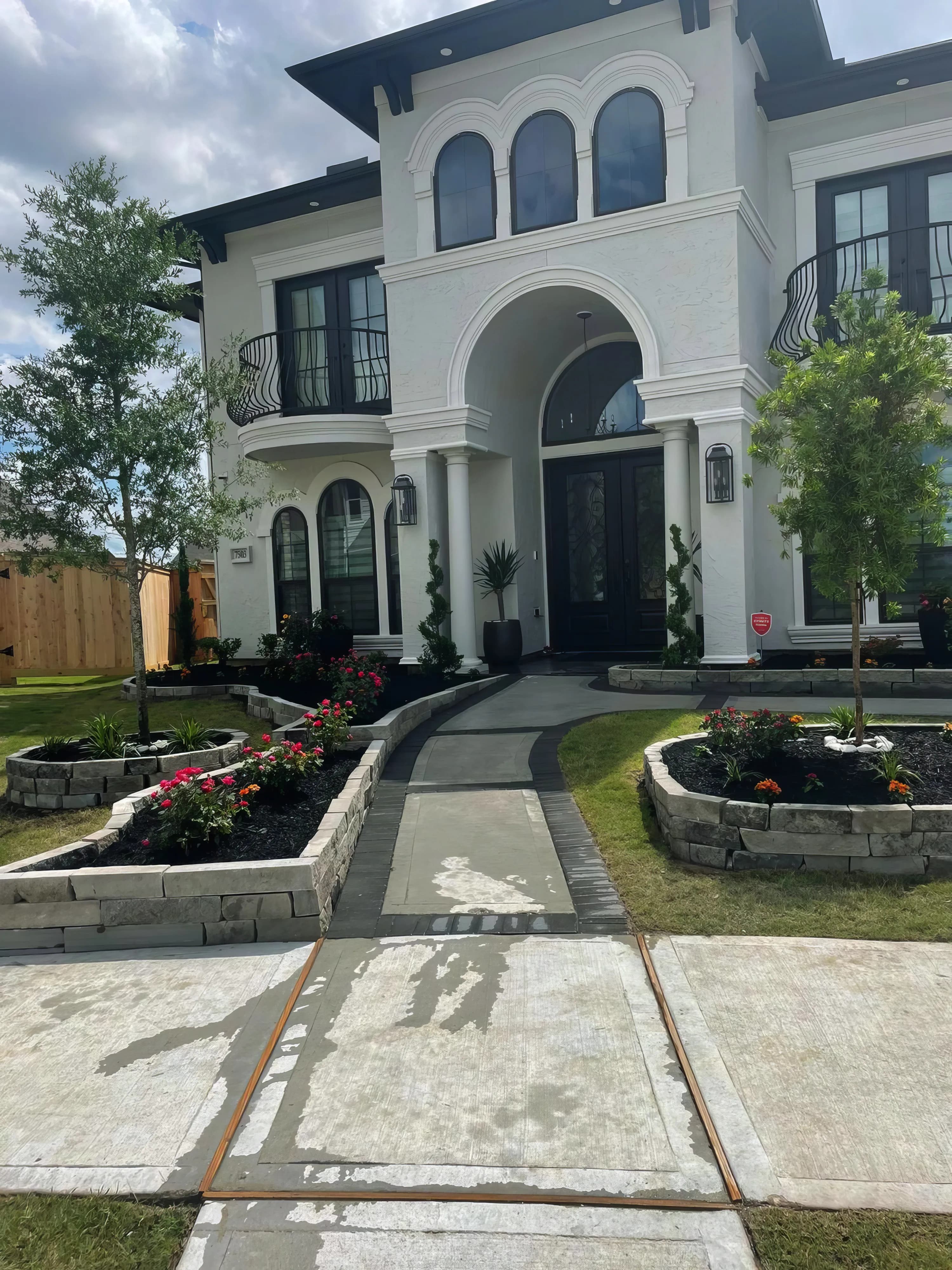
The first thing a buyer sees when they pull up to your house isn't your front door. It's the driveway. Cracked, sunken, or stained concrete telegraphs deferred maintenance before anyone steps out of the car — and in a neighborhood like Pearland or Sugar Land where every fourth house has fresh landscaping and a clean two-car apron, the contrast is brutal. If you've been putting off a driveway replacement or a new front-walk pour, late April is the window. Not summer. Now.
Here's the reason: concrete cures, it doesn't just dry. That curing process is temperature-sensitive, and once Houston crosses 95°F on a regular basis — which typically happens by mid-June — you're fighting the clock from the moment the truck backs in. High heat accelerates hydration, which sounds productive but actually weakens the slab. You end up with surface cracking inside the first year. We've ripped out plenty of driveways poured in August by contractors who didn't bother with curing blankets or evaporation retarder. It's an ugly conversation to have with a homeowner.
April and early May give you ideal conditions: ambient temps in the low-to-mid 80s, lower overnight humidity than summer, and enough dry days between Gulf storms to let the slab cure properly over its critical first 7 days.
What the Permit Process Actually Looks Like in Houston
A lot of homeowners assume a driveway replacement is a no-permit job. In unincorporated Harris County, that's often true for a straight swap at the same footprint. But if you're widening, adding an apron extension to the street, or working inside city limits — Houston proper, Katy, Pearland, Sugar Land — you'll likely need a permit, and in some cases a floodplain review.
This is not a formality. Houston sits on some of the most flood-sensitive land in the country, and impervious cover rules exist for a reason. Adding 400 square feet of solid concrete to a front yard changes how water moves across your lot. The city wants to know where it's going. If your property drains toward a Brays Bayou tributary, expect a closer look.
Typical permit costs for a residential concrete driveway or walkway project in Houston run $150–$400 depending on scope and jurisdiction. Processing time is usually 2–3 weeks, which means if you want a May pour, you're submitting paperwork now. Not next week. Now.
Before you pull anything, find out:
- Whether your lot is in a FEMA Special Flood Hazard Area (SFHA)
- Your municipality's maximum impervious cover percentage for residential lots
- Whether your HOA has restrictions on driveway materials or width (common in master-planned communities like First Colony or Cinco Ranch)
- If you need a driveway approach permit from TxDOT or your city's public works department for any work near the street connection
That last one catches people. The "approach" — the transition from public street to your private driveway — often falls under a separate permit category, and skipping it can mean tearing out fresh concrete.
The On-Site Reality of a Houston Driveway Pour
Here's where things get interesting. I've walked hundreds of Houston driveways that look fine from the street but are sitting on soil that's been shrinking and swelling for 30 years. Houston's expansive clay — Houston Black, Beaumont Clay, whatever your neighborhood sits on — moves with moisture. A lot. Driveways that weren't properly sub-based when they were poured in the 1980s have been riding that movement ever since.
Before any concrete goes down, we probe the sub-grade. If we're replacing an existing slab, we're looking at what's underneath: compaction, base material (ideally 4–6 inches of compacted crushed limestone or flex base), and whether there's any evidence of tree root intrusion from the live oaks or pine trees that are everywhere in the Heights and Meyerland. A 30-year-old post oak with surface roots is the enemy of a flat driveway.
We also specify 4-inch minimum slab thickness for standard passenger vehicles, stepping up to 5–6 inches in the approach zone where vehicles accelerate and brake. Fiber reinforcement and #3 or #4 rebar on 18-inch centers are standard for anything we pour. Control joints — those intentional saw cuts you see in a finished slab — need to be placed at 10-foot intervals maximum and cut within 24 hours of the pour. Miss that window and the slab decides where it cracks. It will crack. Concrete always does. The goal is to control where.
Choosing Between Broom Finish, Exposed Aggregate, and Stamped Concrete
This is where most homeowners spend the most time and, honestly, it shouldn't dominate the conversation until the structural decisions are locked in. But since you'll be living with this for 20–30 years, it's worth being direct about the trade-offs.
Broom finish is the standard: a stiff-bristled texture dragged across the surface before it sets. It's slip-resistant, easy to maintain, and costs the least. For a 500-square-foot driveway replacement in the Houston metro, you're looking at roughly $6,000–$9,500 fully installed, depending on demo, base prep, and finishing.
Exposed aggregate takes the top layer of cement paste off while the concrete is still green, revealing the stone underneath. It looks sharp, especially on craftsman-style homes in Timbergrove or the older parts of Katy. It's more durable than stamped and easier to repair. The downside: the aggregate texture can be rough on bare feet and harder to keep clean if you have a lot of pine straw or leaf debris.
Stamped concrete is the most visually interesting option — it can mimic pavers, slate, or stone at lower material cost. It's a legitimate choice for a front walkway or decorative pad. But be honest with yourself about maintenance. Stamped concrete requires a resealer every 2–3 years, and in Houston's UV environment, color fading happens faster than the brochures suggest. It's also harder to patch invisibly if it cracks. For a front driveway that's taking daily vehicle load, exposed aggregate or broom finish will outlast stamped concrete with less intervention.
If you want to see what these finishes look like on a front approach, our concrete and masonry services page has project photos from recent Houston installations.
Timing the Pour Around Spring Rain
April in Houston averages about 4 inches of rain, and it rarely comes on a schedule. A good concrete contractor monitors forecasts and won't pour if rain is expected within 8–10 hours — water hitting fresh concrete before it sets ruins the surface finish and weakens the top layer. Plan for the possibility that your scheduled pour day gets pushed once. Budget that flexibility into your timeline.
The honest window for a front-yard concrete project — permit approval, site prep, pour, and cure — is 4–6 weeks from the day you start the process. Start now and you're working in ideal conditions. Wait until late May and you're racing the heat. Wait until July and we're having a different conversation about curing schedules and shade tarps.
If you're chewing on a driveway replacement or new front-walk project, we offer free consultations — /request.