
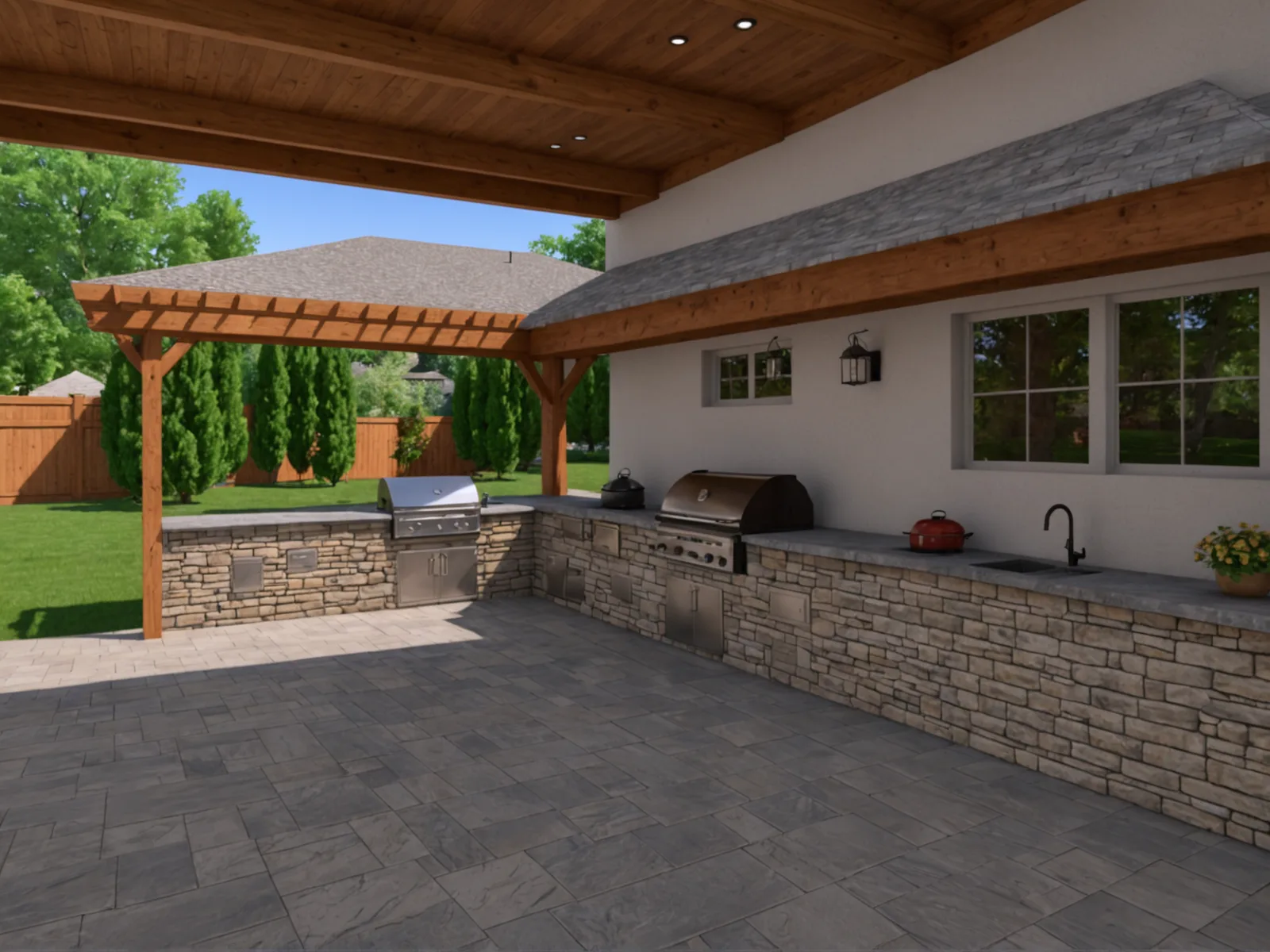
Every spring, the same thing happens. Homeowners call us in April and May wanting an outdoor kitchen done by Memorial Day. The vision is clear: a 14-foot L-shaped counter, built-in grill, mini-fridge, maybe a sink. And we can usually do it. But somewhere in that first conversation, I ask the question that tends to slow things down: "How is this thing going to handle a Category 2 in August?"
Nine times out of ten, they haven't thought about it. Not because they're careless — they've lived in Houston long enough to know better. They just assumed outdoor kitchens were inherently tough, being outside and all. They're not. A poorly planned outdoor kitchen is basically a collection of projectiles waiting on a sustained 100-mph wind to introduce them to your neighbor's fence.
Here's what actually matters before you pour a single yard of concrete.
The Storm Isn't the Only Thing That Will Destroy Your Outdoor Kitchen
Most of the damage we see on outdoor kitchens after a Houston storm isn't from the wind directly — it's from water infiltration that started long before any named storm arrived. Houston's humidity alone is brutal. The summer heat index regularly pushes past 105°F, and then a tropical system dumps 10–15 inches of rain in 48 hours. That thermal cycling, soaking, and baking cycle will find every shortcut in your outdoor kitchen's construction and exploit it.
The biggest offender is the substrate. A lot of outdoor kitchen frames use wood studs — even pressure-treated lumber — because they're cheap and framers know how to work with them fast. On a covered patio in the Heights or Katy, that frame might look fine for three or four years. Then it doesn't. Water gets behind the cladding, the wood swells and contracts with the seasons, and suddenly your beautiful stacked-stone veneer is cracking off in sheets. We've seen it on kitchens that weren't even five years old.
Steel stud framing with cement board sheathing costs more upfront — maybe $2,000–$4,000 more on a mid-size build — but it doesn't rot, it doesn't feed termites (and Houston's termite pressure is no joke), and it doesn't shift under repeated wet-dry cycles the way wood does. That's the trade-off worth naming clearly: wood framing is faster and cheaper now; steel framing is significantly cheaper over a 15-year horizon. If you're building something permanent and you're in this city, the math isn't close.
What Harvey Taught Us About Anchoring and Drainage
After Harvey in 2017, we walked a lot of outdoor spaces across Pearland and Sugar Land that had taken on serious water. The outdoor kitchens that failed worst weren't the ones that flooded — flooding was inevitable in some of those yards. The ones that failed worst were the ones that trapped water. Poor drainage design turned what should have been a soaked-but-intact structure into a waterlogged, mold-incubating wreck.
Good outdoor kitchen design for Houston means the slab slopes. Minimum ¼-inch drop per linear foot, directed away from the house and toward a drain or permeable edge. We also account for where the water comes off the roof or pergola above — a 10-foot covered structure can dump a surprising volume of water in a concentrated area during a heavy band, and if that water has nowhere to go but pool at your base cabinets, you'll regret not planning for it.
Anchoring matters just as much. Freestanding grills and refrigerators become airborne at sustained winds that Houston sees in a moderate hurricane. If your build includes appliances that aren't fully integrated, they need to be secured — either bolted through the counter frame or stored inside before a storm arrives. Built-in appliances with proper mounting are genuinely better from a storm-resistance standpoint. They're also more expensive. There's that trade-off again.
On-site, the thing we check before finalizing layout is the direction the structure opens relative to the prevailing storm-wind direction. In Houston, significant tropical systems tend to push wind from the east and southeast. A kitchen with a fully open face oriented southeast — no wall, no screen, no pergola post arrangement to break the load — is going to take the brunt of that. Sometimes the homeowner's preferred layout and the smart storm-resistance layout are the same. Sometimes they're not, and that's a conversation worth having before the slab is poured.
Materials That Actually Hold Up in a Houston Summer (and Everything Else)
Choosing finishes for an outdoor kitchen in Houston isn't the same as choosing finishes for a kitchen in Denver or Scottsdale. The combination of UV intensity, humidity, and storm exposure narrows the field considerably. Here's what holds up and what doesn't:
Holds up:
- Porcelain tile countertops and cladding (non-porous, UV-stable, low maintenance)
- Concrete countertops with proper sealing (dense, heavy, anchored by weight alone)
- Marine-grade or 304/316 stainless steel for all exposed appliances and hardware
- Powder-coated aluminum for any structural or decorative metalwork
Avoid or approach carefully:
- Natural stone countertops without aggressive sealing schedules — granite and travertine are porous and will stain and crack under thermal shock
- Composite wood decking or trim in direct sun and rain exposure — the fading and warping are faster in Houston's climate than manufacturers typically advertise
- Outdoor-rated cabinetry with wood doors instead of stainless or polymer — even "weather-resistant" wood doors need to be pulled or protected before a storm
The other thing worth specifying clearly: your grill hood exhaust. We've seen outdoor kitchens where the hood was mounted too close to the ceiling of a pergola, with no calculation for airflow — the homeowner then discovered their pergola ceiling was charring. A proper heat-load calculation for a built-in grill setup isn't optional. It's something we build into the design phase, not something we figure out after the fact. Check out our outdoor living spaces service page if you want to see how we approach full outdoor kitchen builds from the ground up.
Before You Commit to a Layout, Check the Permit
Houston's permit requirements for outdoor kitchens depend on what's connected and where. A freestanding, non-gas, non-electric structure may not require a permit. Add a gas line or electrical circuits — which you almost certainly will — and now you're pulling permits, and those permits will involve inspections that have real consequences if the work isn't done right.
Unincorporated Harris County and the city of Houston handle these differently. Some HOA communities in Katy and Sugar Land add their own overlay. Getting this wrong doesn't just mean a failed inspection — it can mean problems with your homeowner's insurance claim after a storm, which is exactly the moment you need your insurance working for you, not looking for reasons to decline.
Plan the permits before you plan the party. It's less exciting, but it's the move.
If you're already sketching layouts and want a straight conversation about what makes sense for your property and your budget, we offer free consultations — /request.