
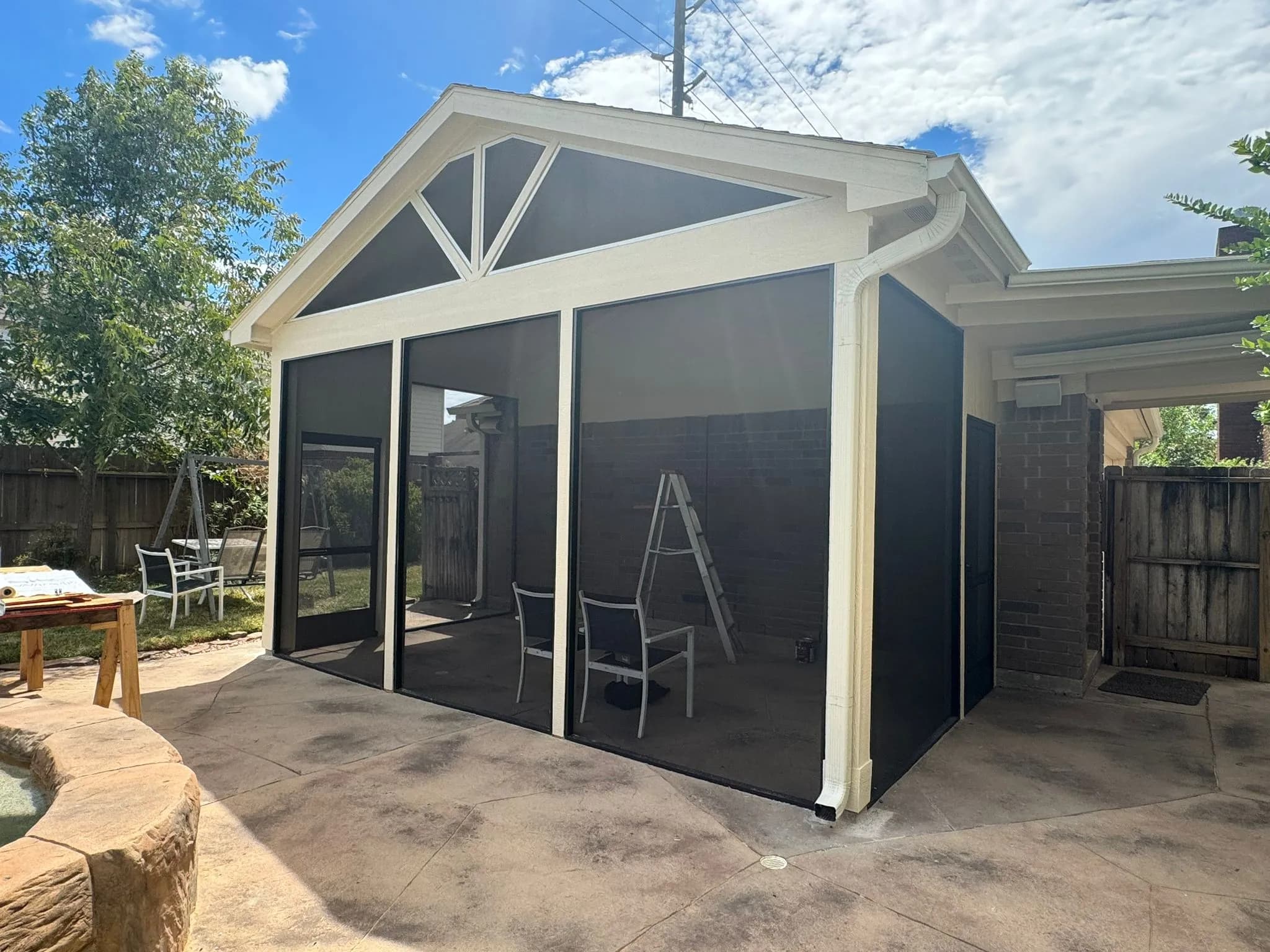
The call usually goes the same way. A homeowner in Pearland or Katy has outgrown their house — new baby, aging parent, finally committing to a home office that isn't the kitchen table — and they want to add a room. They've done some searching, landed on a number they saw on a national website, and they want to know if that number is real. It almost never is.
Room additions in Houston are a different animal than what the national averages suggest, and not always in the direction you'd hope. The clay soil, the slab foundation quirks, Harris County's permitting process, and the sheer scale of humidity that gets trapped inside framed walls before they're closed — all of it shapes what a project actually costs and how long it actually takes. After 20 years of building additions across this region, here's what I tell people before they commit to anything.
What the Permit Process in Harris County Actually Requires
Let's start where most contractors don't: the permit. Houston is one of the few major American cities without traditional zoning, which sounds liberating until you realize it means deed restrictions, HOA rules, and MUD regulations all fill that vacuum with varying levels of intensity depending on your subdivision. Pull a permit through the City of Houston or your municipality — Sugar Land, Pearland, and Katy all have their own building departments — and you're looking at a process that runs 4–8 weeks from submission to approval for a standard room addition, assuming your plans are clean the first time.
That last part matters. Incomplete or under-detailed drawings are the single biggest cause of permit delays we see. The City of Houston requires stamped engineered drawings for most structural additions. That means you're paying an engineer before you pay a framer. Budget $800–$2,000 for the engineering package alone, depending on complexity. Permit fees themselves are calculated on project valuation and typically run $500–$1,500 for a room addition in the $80,000–$150,000 range.
A few things your permit will trigger that homeowners often don't expect:
- A foundation inspection before any framing begins
- Framing inspection before walls are closed
- Mechanical, electrical, and plumbing rough-in inspections (if your addition touches any of those systems)
- Final inspection before the space can be occupied or the permit closed
Each inspection has to be scheduled, and in busy periods — like spring, when everyone is racing to break ground before summer — scheduling lags of 5–10 business days per inspection are common. Build that into your timeline. Don't plan around it disappearing.
What Houston's Soil and Slabs Do to Your Budget
Here's where national cost estimates fall apart for Houston homeowners. The expansive clay soil across most of Harris County and the surrounding suburbs means your addition's foundation is not a simple concrete pour. It's a conversation.
On-site, this is what it looks like: before a single frame goes up, a geotechnical report often needs to confirm soil bearing capacity. If the existing slab is post-tensioned — which is extremely common in Houston homes built after the late 1980s — cutting into it for a tie-in requires a structural engineer to identify and reroute cables. Cut the wrong cable and you've cracked a slab that was holding tension across the entire footprint. We've seen this turn a straightforward addition into a $15,000 problem on projects where the homeowner assumed the slab work was a line item, not a decision point.
Pier-and-beam homes in the Heights or Montrose add a different wrinkle: the addition foundation has to match the movement characteristics of the existing structure, or you get differential settlement — meaning the new room slowly separates from the old one. That's a $3,000–$8,000 foundation upgrade that never appears on the estimates homeowners get from contractors who haven't worked these neighborhoods.
The honest trade-off here is this: a detached structure — a standalone ADU or studio in the backyard — avoids the foundation tie-in problem entirely and often permits more straightforwardly. The downside is that it's genuinely detached. No climate-controlled hallway connection, no access during a Houston thunderstorm without getting wet. For some households that's fine. For others it defeats the purpose.
What a Realistic Timeline and Budget Look Like
For a typical attached room addition in the Houston metro — one room, roughly 300–400 square feet, with basic electrical and climate control added — here's what the realistic picture looks like:
Design and engineering: 3–5 weeks
Permit approval: 4–8 weeks (running concurrently with some design work if you're organized)
Foundation and framing: 2–3 weeks
Rough-in trades (electrical, HVAC, plumbing if applicable): 1–2 weeks
Inspections and close-in: 1–2 weeks (accounting for scheduling lag)
Drywall, finishes, and punch list: 3–5 weeks
Total: roughly 4–6 months from first drawing to final inspection. Projects that start in May, with clean plans and a contractor who has a real relationship with the local inspection office, can realistically finish before the holidays. Projects that start in July, in the middle of the inspection backlog and with crews thinned by heat, often push into the following year.
Budget-wise, a 350-square-foot addition with standard finishes — not luxury, not builder-grade — runs $95,000–$145,000 in the current Houston market. That range assumes no major surprises in the foundation, one HVAC zone added or extended, and mid-range windows and doors. If you want a full bathroom added to the room, add $18,000–$30,000 and at least three more weeks.
The projects that come in under $80,000 for an attached addition almost always have a catch — either the scope is genuinely simpler than described, or the contractor isn't carrying the right insurance, or the permit is being skipped entirely. A room addition without a permit in Harris County creates a title problem when you sell. It's not a gray area.
If you're weighing a room addition against other options, our home additions and conversions page walks through the different project types we handle and what typically makes sense at different square footages and budgets.
May is genuinely the right time to be having this conversation, not because of any seasonal promotion, but because the projects that start design work now are the ones that clear permitting before the summer slowdown hits inspectors and crews alike. The ones that wait until August are fighting a different calendar entirely.
If you're chewing on whether an addition makes sense for your home and budget, we offer free consultations — reach out here and we'll tell you what we'd actually expect to find on your lot before any numbers get committed to paper.