
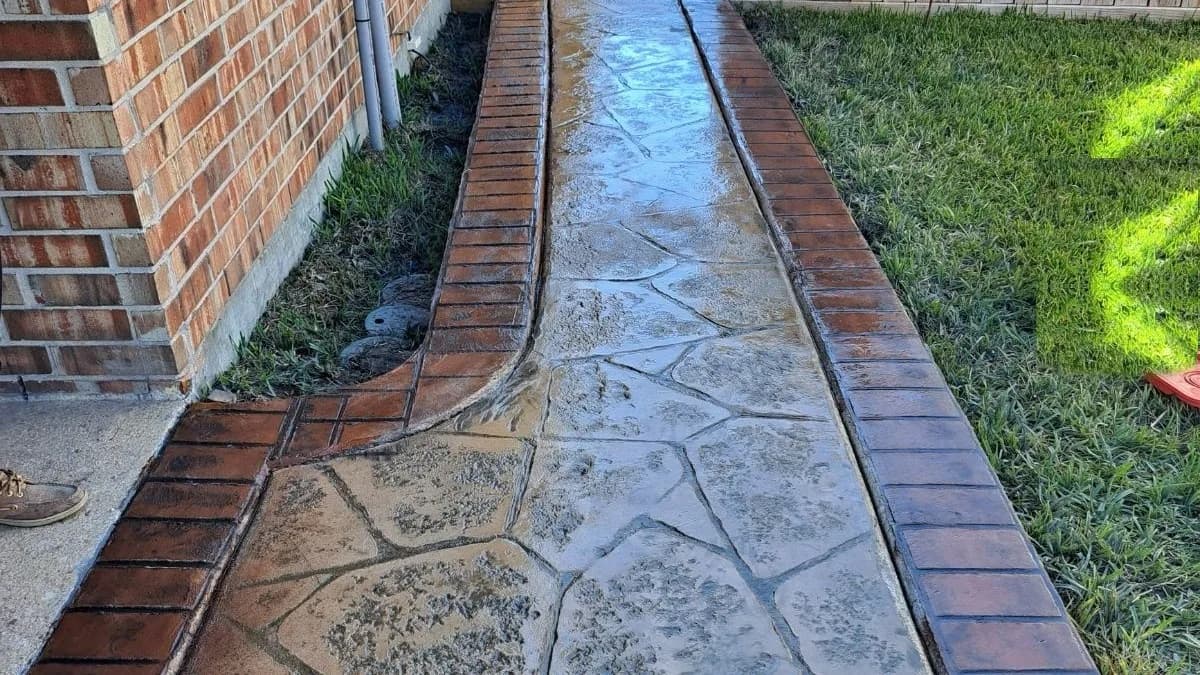
The truck showed up at 10 a.m. on a July morning in Sugar Land, concrete already stiffening in the drum before the chute was fully extended. By the time the finisher got to the back half of the slab, it had lost so much workability that he was fighting it with a float instead of guiding it. The result: a surface that looked acceptable for about eighteen months, then started dusting and scaling right along the lines where the crew had been working against the clock. The homeowner had no idea the timing of the pour — not the mix, not the base prep, not the thickness — was what doomed that driveway.
This is the thing about Houston concrete work in summer that nobody tells you upfront. The enemy isn't always a bad contractor or cheap materials. Sometimes it's just the calendar.
What Houston Heat Actually Does to Concrete
Concrete doesn't dry. It cures — a chemical reaction between cement and water called hydration. That reaction is temperature-sensitive in a way that bites hard in a Houston June.
When ambient air temperatures climb past 90°F and ground surface temperatures push past 100°F (which they routinely do here between June and September, especially on dark asphalt and sun-baked soil), the water in your concrete mix evaporates faster than the hydration reaction can use it. The result is a slab that looks set but is internally weak — prone to cracking, scaling, and surface dusting within a season or two.
The ACI 305 standard — the concrete industry's hot-weather guidelines — kicks in at 90°F. Houston sits above that threshold for roughly 4–5 months of the year. We're not talking about a temporary inconvenience. We're talking about a structural condition that has to be actively managed or worked around entirely.
There's also the thermal gradient problem. A slab poured in direct afternoon sun can have a surface temperature 20–30 degrees higher than the concrete just a few inches below. That differential creates internal stress as the concrete sets unevenly — which is exactly how you get random cracking that no amount of control joints fully prevents.
The Actual Playbook for Pouring in Houston Summer
The window is real but narrow. It hasn't closed yet in mid-June, but it's closing fast. Here's what working concrete in summer heat actually requires — not in theory, but on a Houston job site:
- Pour before 7 a.m. A 5:30 or 6 a.m. first truck is not unusual for us on summer slabs. Ground temps are lower, radiant heat from the sun hasn't built up, and you're finishing before the worst of the afternoon.
- Pre-wet the subgrade. The night before a pour, the base should be dampened — not saturated, dampened. Dry soil and base rock will wick moisture out of the bottom of the slab before hydration is complete.
- Use a water-reducing admixture. This lets the batch plant reduce the water-to-cement ratio without losing workability, which tightens the mix without giving you something unworkable in the heat.
- Ice the mix water. Serious summer pours in Houston use chilled or iced mix water at the plant to lower the concrete's initial temperature. A target fresh concrete temperature of 85°F or below is the standard. Every 10°F drop in mix temperature buys you roughly 1 extra hour of working time.
- Cure immediately and aggressively. Wet-cure curing compound, curing blankets, or continuous misting — applied as soon as the bleed water clears. Not an hour later. Not after lunch.
- Stay off bare-dirt staging. Tools, wheelbarrows, and equipment sitting on the poured slab reflect and trap heat. Keep the slab surface shaded wherever possible.
Miss two or three of these and the pour date stops mattering. You've already lost.
What This Looks Like On-Site in a Houston Backyard
I've watched good crews do everything right and still get surprised by Houston. One job in the Heights — a 400-square-foot patio slab, straightforward except for the existing pier-and-beam structure nearby — required us to hand-dig the perimeter to avoid undermining the existing footings. That slowed staging. By the time the concrete was placed fully, we were 45 minutes deeper into the morning than planned, ambient temp already at 93°F.
The finisher caught it. He called for the curing compound immediately rather than waiting for full bleed-water evaporation. We misted. The slab came out clean. But it was a closer call than the homeowner ever knew, and it happened because a structural constraint — the footing clearance — pushed us into a hotter part of the day. That's the kind of thing you don't account for sitting at a kitchen table with a quote sheet. It only shows up on-site.
The honest trade-off worth naming: if you wait until October or November, you get dramatically better curing conditions — cooler air, lower ground temps, slower evaporation — and meaningfully less risk of surface defects. The downside is that you're waiting 4–5 months, and if you want a finished outdoor space before next spring, fall doesn't help you. Pouring now, done correctly with early-morning scheduling and proper admixtures, produces a durable slab. Pouring now with a crew that shows up at 11 a.m. and skips the curing compound produces one that'll embarrass you by 2028.
If you're deciding between acting in the next few weeks or waiting until fall, that's actually a reasonable debate. Fall concrete is easier concrete. But summer concrete, done right, is not a gamble — it's just a tighter operational window that has to be respected.
We do this work throughout Houston, from Pearland to Katy, and our concrete and masonry services are built around the reality of this climate, not some generic national standard that treats July in Houston like July in Denver.
If you're chewing on a patio or driveway project and want a straight answer about timing and what it'll actually take, we offer free consultations — request one here.