
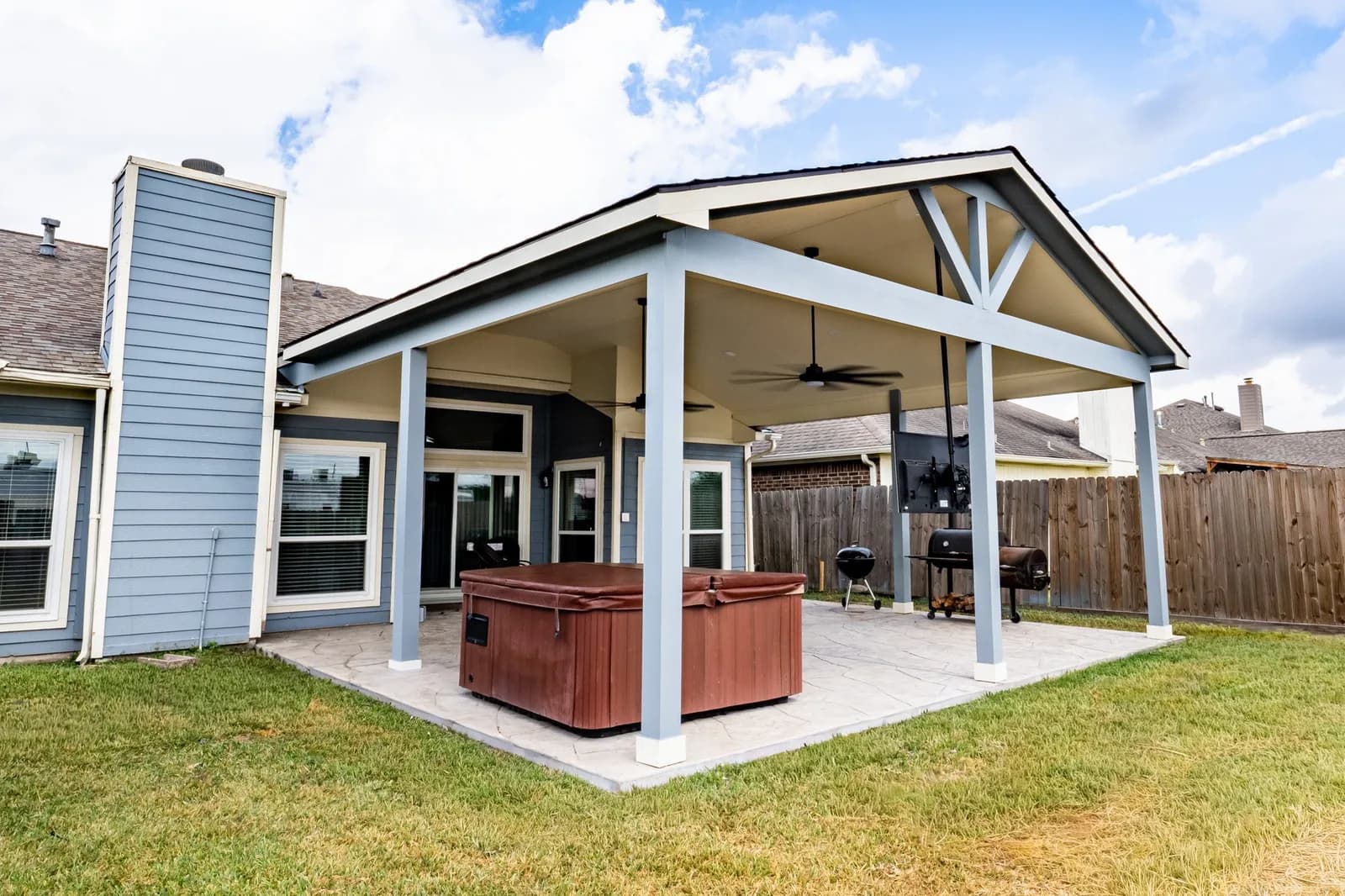
Every year around late October, we start getting the same call. Someone's hosting Thanksgiving — maybe Christmas too — and they've just looked at their back patio and realized it's a cracked concrete slab with a sun-bleached umbrella stand. They want it fixed before family arrives. That's a legitimate goal. Whether it's achievable depends entirely on when they call and what they're actually asking for.
Houston's outdoor season runs November through February. That's not a marketing angle — it's just physics. When the heat index drops below 90 and you can sit outside without soaking through a shirt, people actually use their patios. If you're planning a remodel to take advantage of that window, you need to understand the real timeline, the real constraints, and where the decisions that seem small will cost you later.
The Timeline Is Shorter Than You Think
A full patio remodel — concrete demolition, new slab or stamped overlay, cover structure, electrical for fans and lighting — runs 3–5 weeks from permit pull to punch list on a typical Sugar Land or Pearland lot. That assumes no surprises. In Houston, there are usually surprises.
Permits are the first chokepoint. Harris County and most surrounding municipalities require a permit for any attached patio cover because it's a structural addition to the home. Fort Bend County's permitting office has been running 7–10 business days for residential approvals lately — that's not in your contractor's control, and it doesn't compress no matter how urgent your timeline feels. Pull that time out of your calendar before you start counting backwards from Thanksgiving.
The second chokepoint is concrete cure time. A new slab needs a minimum of 28 days to reach full compressive strength, though it's typically walkable at 7 days. If you're doing stamped concrete with a color hardener and sealer — which looks sharp and is genuinely popular right now for good reason — the sealer needs dry, mild conditions to cure properly. November in Houston is usually cooperative. October can still throw 85-degree days that flash-cure the sealer and leave you with a blotchy finish. Timing matters more than people expect.
What Harvey (and Every Storm Since) Taught Us About Drainage
I've walked patios after Beryl where the homeowner spent $18,000 on a beautiful stamped concrete slab and a cedar pergola, and the whole thing pooled water because nobody accounted for the existing yard grade. The slab sloped slightly toward the house — maybe 1/8 inch per foot, barely visible — and every heavy rain pushed water against the foundation.
Houston's soil is notoriously expansive clay. It moves. A patio slab poured directly onto poorly compacted fill, or without proper caliche base, will shift and crack within two or three years. This is the constraint that separates a remodel that still looks good in 2031 from one that's already heaving by 2028. On-site, what this looks like is a crew spending half a day compacting a 4-inch crushed limestone base before a single yard of concrete gets poured. Some contractors skip this step to save time and margin. Ask specifically whether it's in the scope.
For drainage, the right grade on a Houston patio is a minimum 1/4-inch drop per foot away from the structure. On a 14-foot deep slab, that's 3.5 inches of fall from the house edge to the outer edge. It's not dramatic. You won't notice it when you're sitting at a table. But your foundation will notice, for decades.
A few things worth verifying before your project starts:
- Confirm the proposed slab grade with your contractor — get the number, not just "we'll slope it away from the house"
- Ask whether the existing drainage swale in your yard will handle patio runoff without backing up
- If you have a covered patio, make sure downspouts are included in the plan and routed to the yard, not pooling at the slab edge
- For any project near a fence line, check your setback requirements — most Houston-area municipalities require 3–5 feet from the property line for permanent structures
Choosing a Cover: Wood, Aluminum, and the Trade-Off Nobody Mentions
The most common debate we have with homeowners is wood pergola versus insulated aluminum patio cover. Both are good options. They're not equal options.
An insulated aluminum cover — the kind with a solid panel roof that actually blocks radiant heat — runs $85–$120 per square foot installed for a quality system on a 12-by-16-foot space. It's not cheap. What you get is a cover that meaningfully reduces the temperature underneath it, handles Houston's UV load without fading or warping, and requires essentially zero maintenance. In ten years, you'll clean it with a hose.
A wood pergola, by contrast, costs less upfront — typically $40–$65 per square foot installed for cedar or pressure-treated pine — and looks warmer and more architectural. The honest downside: it's open by design. A pergola doesn't block sun the way a solid cover does, which in Houston means your patio is still brutal from April through September. And wood in our climate, with the humidity cycling we get coming off the Gulf, needs to be sealed or stained every 2–3 years or it starts to grey and check. That's not a dealbreaker. It's just a recurring cost and effort that aluminum doesn't carry.
If your primary goal is year-round usability and you entertain heavily, the aluminum cover earns its premium. If you want a beautiful space for the November–February season and you're comfortable with the maintenance schedule, cedar does things aluminum can't do aesthetically.
The decision changes again if you're adding a ceiling fan, recessed lighting, or a mounted heater — all of which are worth doing in Houston because even our mild winters get cold enough some evenings to want a radiant heat source overhead. Running electrical through an aluminum panel system is straightforward. Running it through an open wood pergola requires surface conduit or careful pre-planning of beam routing. Neither is impossible. One is cleaner.
Our outdoor living spaces work covers both systems, and we've done enough of each to give you an honest side-by-side based on your specific yard and how you actually use the space.
If you're chewing on a patio project and want to know what it would realistically cost and when it could be done, we offer free on-site consultations — fill out the form at /request and we'll come take a look. No pressure, no pitch. Just a conversation about what your yard can actually do before December.